

Corporation Tax Financial Year Explained: Why Your Profits Must Be Split Between Two Years
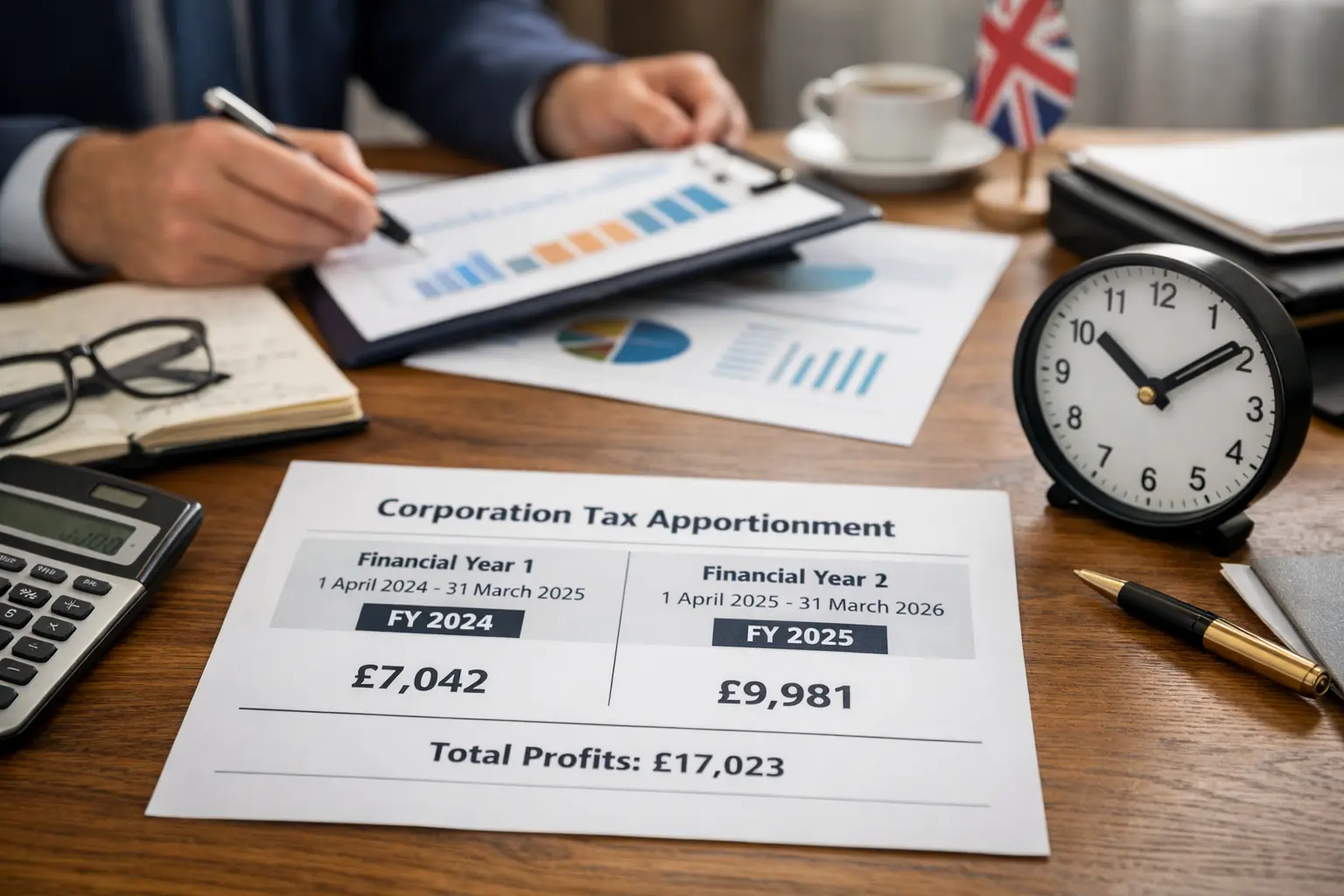
If your company’s accounting period does not align with 31 March, your Corporation Tax calculation may need to be split across two UK financial years.
This often causes confusion for directors and even junior accountants. In this article, we explain clearly how Corporation Tax financial years work, why profit apportionment is required, and how HMRC expects it to be calculated.
At S & B Accountants Ltd – Chartered Certified Accountants in East London, we frequently advise small businesses on this issue.
What Is a Corporation Tax Financial Year?
In the UK, the Corporation Tax financial year (FY) runs from:
1 April to 31 March
This is set by statute under the Corporation Tax Act.
Your company’s accounting period may be:
1 January – 31 December
1 November – 31 October
Any other 12-month period
But Corporation Tax rates are applied by reference to the government’s financial year, not your company’s year-end.
When Does Profit Need to Be Split?
If your accounting period spans two financial years, your taxable profits must be time-apportioned between them.
Example
Accounting period:
1 November 2024 – 31 October 2025
This period crosses:
FY 2024 (1 April 2024 – 31 March 2025)
FY 2025 (1 April 2025 – 31 March 2026)
Therefore, profits must be split between the two.
Important: HMRC Requires Apportionment by Days (Not Months)
Many business owners assume profits are split:
5 months in one year
7 months in the next
This is incorrect.
Under CTA 2010 s.1172, HMRC requires time apportionment by exact number of days.
Step-by-Step Breakdown
Accounting period: 1 November 2024 – 31 October 2025
Total days = 365
Days falling in:
FY 2024 → 151 days
FY 2025 → 214 days
If total profit = £17,023
Apportionment:
FY 2024 → £17,023 × (151 / 365) = £7,042
FY 2025 → £17,023 × (214 / 365) = £9,981
Your accounting software should calculate using this daily method.
What Corporation Tax Rate Applies?
For FY 2024 and FY 2025:
Small Profits Rate: 19% (profits up to £50,000*)
Main Rate: 25% (profits above £250,000*)
Marginal Relief applies between £50,000–£250,000
* Thresholds are reduced if there are associated companies.
In lower-profit cases, the split does not change the total tax because the rate is the same. However, if rates differ between financial years, correct apportionment becomes critical.
Why This Matters for Small Businesses
Incorrect apportionment can:
Lead to inaccurate CT600 submissions
Trigger HMRC queries
Distort marginal relief calculations
Affect quarterly instalment payment thresholds
Professional review is particularly important for:
Growing businesses
Property companies
Companies near the £50,000 or £250,000 limits
Groups with associated companies
How We Help
At S & B Accountants Ltd – Accountants in London, we provide:
Corporation Tax planning
CT600 preparation and filing
Marginal relief calculations
Associated company analysis
Year-end tax optimisation
If you are searching for:
Accountants in East London
Small business accountants
Accountants near me
Corporation Tax advice London
Our team can assist.
Frequently Asked Questions (FAQs)
1. Do I always need to split profits between financial years?
Only if your accounting period overlaps two UK financial years.
2. Can I split profits by months instead of days?
No. HMRC requires time apportionment by exact days, not calendar months.
3. Does splitting profits change the tax amount?
Not if the Corporation Tax rate is identical in both financial years.
However, if rates differ, the split directly affects your tax liability.
4. What happens if rates change in April?
Your profit before 1 April is taxed at the earlier rate.
Your profit after 1 April is taxed at the new rate.
5. Does this affect marginal relief?
Yes. Marginal relief calculations are performed separately for each financial year portion.
Meta Description (SEO Optimised)
Corporation Tax financial year explained. Learn how UK companies must split profits across financial years using daily apportionment. Expert advice from accountants in East London.
Suggested Target Keywords
Corporation Tax financial year UK
Profit apportionment Corporation Tax
Corporation Tax split between financial years
Accountants in East London
Small business accountants London
Corporation Tax advice London
Accountants near me